Last Updated on November 27, 2026
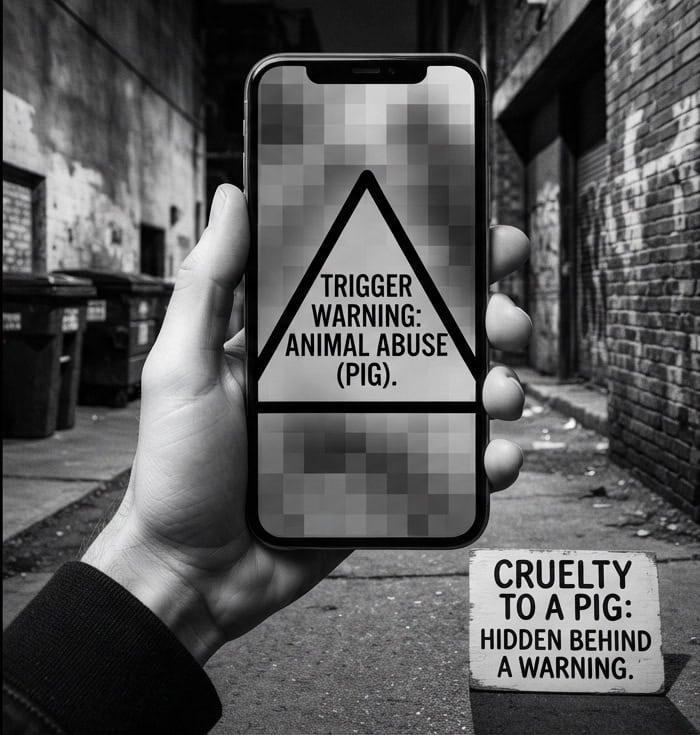
When graphic footage of animal abuse appears online, consumers often demand trigger warnings to shield themselves from discomfort. Yet the animals inside slaughterhouses, fur farms, and laboratories never receive a heads-up before experiencing actual violence. Slapping a blurred cover over the truth defeats the purpose of animal rights activism by giving people an easy exit ramp from their own complicity. True advocacy isn’t about protecting human feelings—it’s about forcing society to confront the reality behind the products they buy, eat, and wear.
Whenever I post graphic footage of animal abuse on my social media, people complain that there is no trigger warning. They want a heads-up before they have to look at what happens inside slaughterhouses, fur farms, laboratories, or on the street.
I never use trigger warnings.
Because the victims never get a trigger warning.
Why I Don’t Use Trigger Warnings for Animal Abuse Footage
Nobody warns a pig before she is lowered into a gas chamber. Nobody warns a cow before a bolt is shot into her skull. Nobody warns a chick before he is dropped alive into a macerator, or a fox before he is electrocuted for a coat collar.
They do not get a gentle buffer, a blurred screen, or the option to scroll past because today feels inconvenient. They are forced to live through the actual violence, while the humans paying for it demand to be protected from even looking at a video of it.
How Graphic Slaughterhouse Footage Activism Exposes Complicity
The whole point of sharing this footage is to force people to confront what they support. The second you slap a trigger warning or a blurred cover over an image, people skip right past it. That is the exact opposite of what we are trying to do as activists. Giving people an easy exit ramp defeats the entire purpose of showing the truth in the first place.
A trigger warning exists to protect someone from reliving trauma they did not choose. Non-vegans scrolling past slaughterhouse footage are not victims of slaughterhouse violence. They are the consumers funding it. Asking for a warning so you can avoid seeing the reality of who you oppress, eat, wear, and buy is not self-care. It is cowardice.
You want the pleasure, the habit, and the convenience, just without the guilt of witnessing your victim.
The Double Standard of Showing Slaughterhouse Videos on Social Media
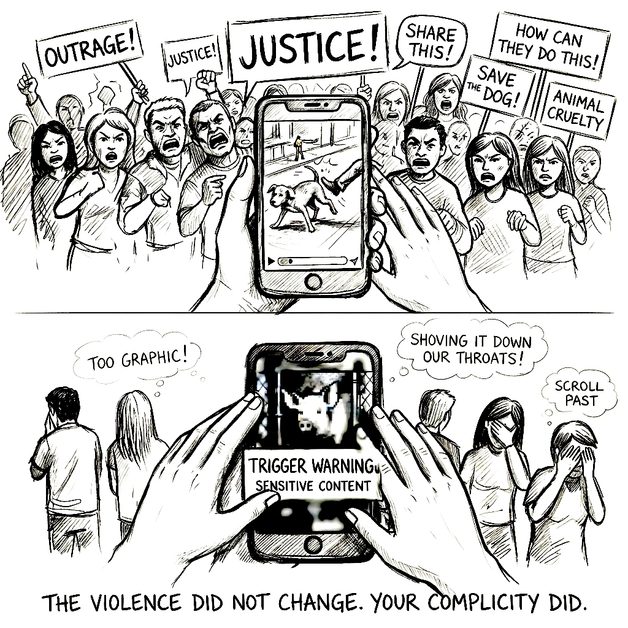
Look at how quickly that sensitivity disappears when the victim is a dog or a cat. If a video of a dog being kicked in the street shows up on your feed, nobody asks for a trigger warning. Everybody watches, everybody shares it, and everybody demands justice. The outrage only vanishes when the victim is someone you pay to have killed. Suddenly the footage is “too graphic,” “too extreme,” or “shoving it down people’s throats.” The violence did not change. Your complicity did.
Abolitionist Vegan Activism vs. Protecting Consumer Comfort
Even worse, plenty of so-called vegans complain about the lack of trigger warnings too. They completely forget, or deliberately dismiss, the fact that when abolitionist vegans post these horrific images, it does not make us happy. None of us enjoy looking at tortured animals, downloading the footage, or spending our time sharing it. It breaks us every single time. We do not post it for other vegans. We post it for non-vegans, to bring awareness to the reality they keep hidden behind closed doors.
I am an animal rights activist, not a people’s feelings activist. My responsibility is to the victims, not to the comfort of the people paying for their exploitation, and not to the comfort of people who would rather keep the peace than confront the truth. If looking at what happens to animals ruins your mood, good. Let it ruin your mood. Let it ruin your meal.
The problem is not that you saw the violence on your screen. The problem is that it is happening at all.
“”You may choose to look the other way, but you can never say again that you did not know.”
— William Wilberforce (Co-Founder of RSPCA)
Animal lover? Check out A Guide to Going Vegan For the Animals for more ways to show your love for animals. Brought to you by The Vegan Experience.



Cristina C is a Romanian-born abolitionist vegan writer whose work centers animal liberation, feminism, and ethical accountability. Her perspective is shaped by migration, resilience, and a commitment to confronting normalized harm.